Lead
For five trading days we let the Konclave morning briefing run completely unedited across a live equity book. No human pass before it hit the PM’s inbox. It was fast, it was broad, and it was wrong in one specific, repeatable way that is worth naming.
What it did well
Coverage was total. Every name in the book got a look every morning, which no human desk achieves. Overnight filings were summarized correctly. Earnings previews were accurate on the numbers. Not one hallucinated figure in five days, because every figure is pulled from a structured source and cited inline.
The repeatable miss
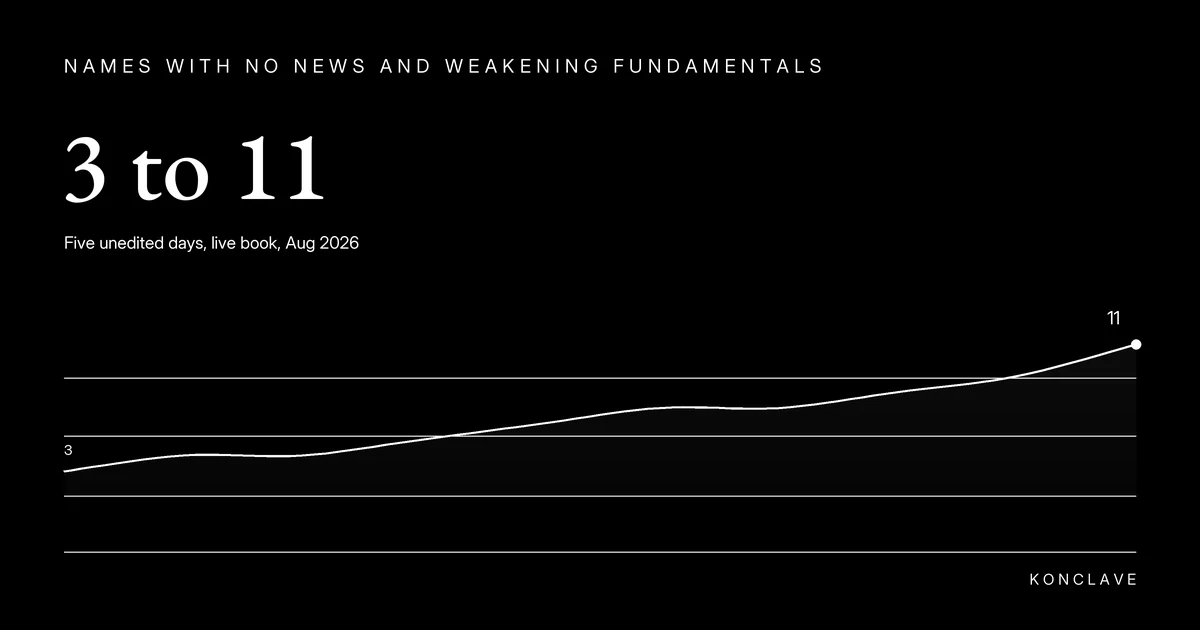
The briefing consistently overweighted recency. A name with three days of news flow got ranked above a name with a slow-moving but material change, a customer concentration creeping up across two quarters, a mix shift visible only in week-over-week distributor data. The agent saw the loud thing. It did not naturally see the quiet compounding thing.
This is not a bug in the summarizer. It is a property of attention: news flow is legible, drift is not. Fixing it required a separate pass that explicitly looks for names with no news and deteriorating fundamentals, and forces them into the briefing.
Why we publish the miss
A desk evaluating agentic tooling should ask every vendor the same question: what does your system systematically not see? If the answer is nothing, the answer is marketing. Ours is recency bias, and the fix is a second agent whose only job is boredom.
Demonstration article published to show the Konclave News format.