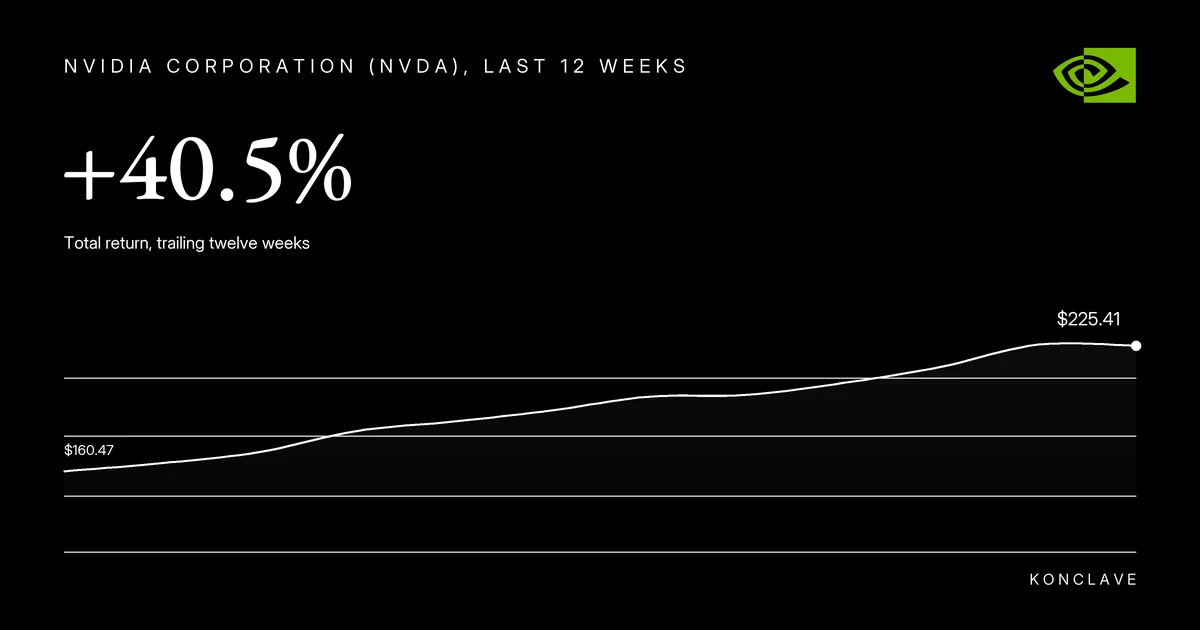
NVIDIA’s (NASDAQ: NVDA) data-center mix is shifting toward inference SKUs faster than the street’s 2027-weighted model assumes. The Konclave screening stack flagged the shift across supplier lead times and hiring mix eight weeks before the last print. The investable implication is not unit volume. It is data-center gross margin, which consensus still treats as stable.
The change
Over the twelve weeks to mid-August, the desk’s screening stack recorded three independent observations pointing at the same line item. Application-engineer postings tied to inference runtime rose while training-cluster postings were flat. Two large ODMs republished lead-time tables with inference SKU slots pulled forward. Distributor language in public tenders shifted from training-cluster bundles to mixed inference racks. Individually each is weak. Together they describe a mix change, not a demand spike.
Why the market has not fully priced it
The prevailing consensus assumption is that inference is a 2027 revenue story and that 2026 remains a training-capex year. That assumption is visible in mix models that hold data-center gross margin roughly flat through the next two prints. The desk’s observation is that mix is moving now, in SKU mix and in the hiring that precedes it, while the margin model has not been rewritten.
This is not a claim that the street has not noticed inference. It is a claim that the street has noticed the category and has not yet priced the timing of the mix shift.
Evidence
The screening stack does not forecast revenue. It flags dated, weak signals that share a line item. In this case the shared line item is data-center SKU mix. The three flags fired on the second independent source, not the first. One ODM is noise. Two, plus the hiring mix, is a pattern the monitoring queue then keeps warm.
What the data shows: the inference-linked hiring and lead-time signals broke from their own twelve-month baseline in June and have not mean-reverted. What we infer: that break is consistent with a mix shift that would pressure or support data-center gross margin depending on the SKU ASP gap. The inference here is the transmission, not the observation.
The investable bridge
The named security is NVIDIA Corporation, Nasdaq: NVDA. Data center is the company’s core revenue driver. A mix shift inside that segment transmits through ASP and gross margin before it transmits through reported unit volume. If inference SKUs carry a different margin profile than the training mix the street is modeling, the next two prints can miss on margin while beating on revenue, or the reverse. That is the mechanism. It does not require a view on the multiple.
Risks and failure modes
The thesis is wrong if the next two prints show data-center mix and gross margin in line with the current consensus model, or if the hiring and lead-time signals revert to their 2025 baseline without a mix comment from management. It is also wrong if inference SKUs prove margin-neutral, in which case the mix shift is real and still not investable.
A second failure mode: the flags are catching a one-quarter pull-forward of already-planned inference ramps, which the street will absorb at the print and then fade.
What to monitor next
- The next two NVDA prints: data-center gross margin versus the current consensus mix model, and any explicit inference-versus-training mix comment.
- Whether the inference-linked hiring series stays elevated or mean-reverts over the next six weeks.
- A third independent ODM or distributor lead-time change. Two is a pattern. Three is harder to dismiss as a scheduling artifact.
Demonstration thesis published to show the format of Konclave Research. Figures are illustrative of the desk’s screening method, not a claim about NVIDIA’s reported results. This is for informational purposes only and does not constitute investment advice.